


AI Bank Reconciliation Software: How SiRiiL Works and What to Expect
 Nabeel MirzaCo-Founder, CFO & Product Visionary
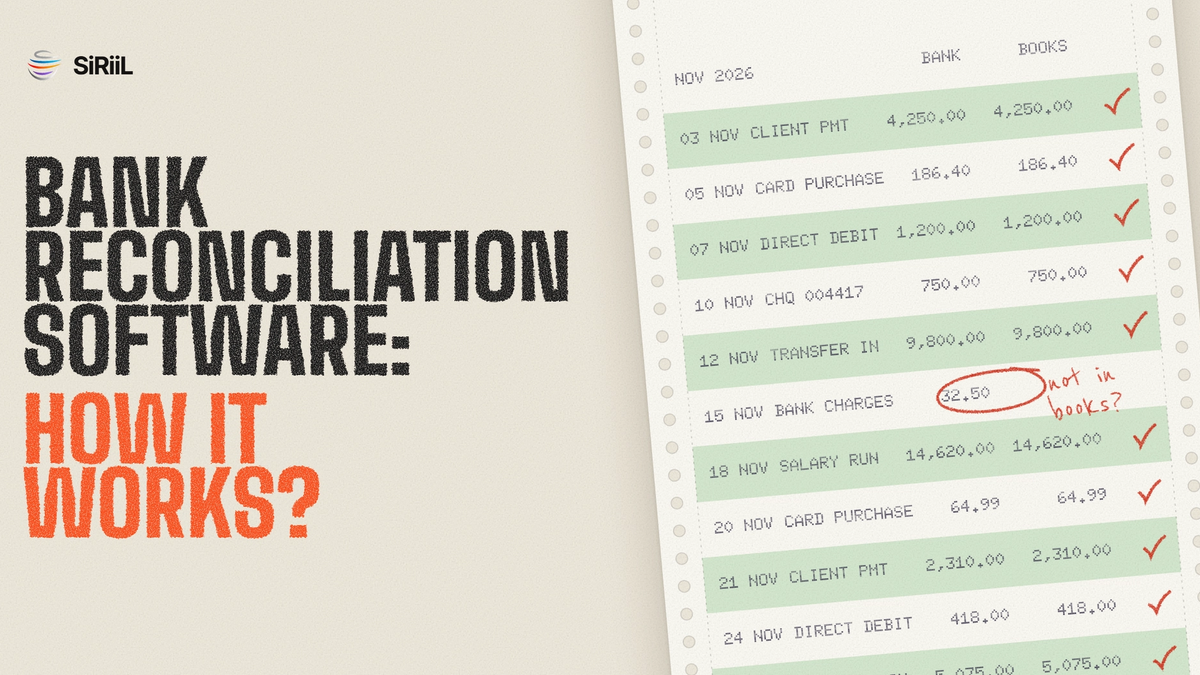
If you work in finance, you know the exact feeling of hitting a wall during month-end close. You pull the bank statements, open the general ledger, and start matching lines. For the first hundred transactions, everything aligns perfectly. Then the spreadsheet chaos begins. A payment clears on Tuesday, but the invoice was recorded on Monday. Bank fees appear without warning. Customers pay lump sums that cover three separate invoices. This forces you to hunt down which amounts add up to the total.
When transaction volumes climb past a few hundred lines per month, manual matching breaks down into hours of stressful spreadsheet scrolling. This friction is exactly why finance leaders are actively looking for reliable AI bank reconciliation software.
However, as accountants, we are naturally skeptical of artificial intelligence touching our balance sheets. We are responsible for the numbers. We cannot hand our ledgers over to a black box and hope the math is right.
If you are researching options or building out your tech stack as outlined in Bank Reconciliation Software: The Complete Guide for 2026, you need to understand how these systems operate beneath the hood. The right software does not replace your judgment. It simply automates the tedious pairing process so you can focus on the exceptions.
Why Basic Bank Rules and Spreadsheets Fail
Traditional accounting software makes bank feeds easier to view, but it rarely solves the underlying reconciliation bottleneck. Built-in bank feeds often rely on rigid, simplistic rules. If a vendor slightly changes their trading name on a bank transfer, or if a payment reference number is missing a single digit, the rule fails.
When those rules fail, accountants resort to exporting data into spreadsheets, writing complex lookup formulas, and color-coding rows to track unpresented cheques and deposits in transit. This manual workaround introduces massive risks.
First, human fatigue leads to errors. Hunting for a $63.00 variance at 2 AM is how mistakes happen. Second, spreadsheets lack institutional memory. When the specific person who handles your reconciliation leaves the company, next month's team starts entirely from scratch. Specialized reconciliation platforms change this dynamic completely. They retain the memory of past decisions and handle messy data formats without requiring rigid column templates.
The Mechanics of a Reliable Matching Engine
To handle those messy data formats safely, reliable financial software takes a strictly disciplined approach. The phrase artificial intelligence often conjures images of autonomous systems making unpredictable financial decisions. In practice, the most effective systems, like SiRiiL, separate absolute mathematical logic from probabilistic AI models. This is how you maintain total control and auditability.
Deterministic Matching for Exact Pairs
Before any machine learning model touches your data, the software applies exact arithmetic and reference matching. Transaction numbers, bank trace references, check numbers, and exact amounts are paired instantly. Because money arithmetic is handled strictly by the underlying code, math errors simply never occur. On clean test datasets, this deterministic engine handles up to 93 percent of transactions without needing AI at all.
Categorizing Unmatched Transactions
Every transaction SiRiiL cannot pair is given a label, such as Bank Charges or Deposit in Transit, and a treatment. If an item appears to be incorrectly classified, SiRiiL provides two options: Relabel and Move. Relabel lets the user fix a wrong label while leaving the item where it is. Alternatively, selecting Move opens a dialog where the user can choose between:
- Adjust the ledger: needs a journal entry
- Carry forward: waiting for the other side
- Investigate: cannot be classified yet
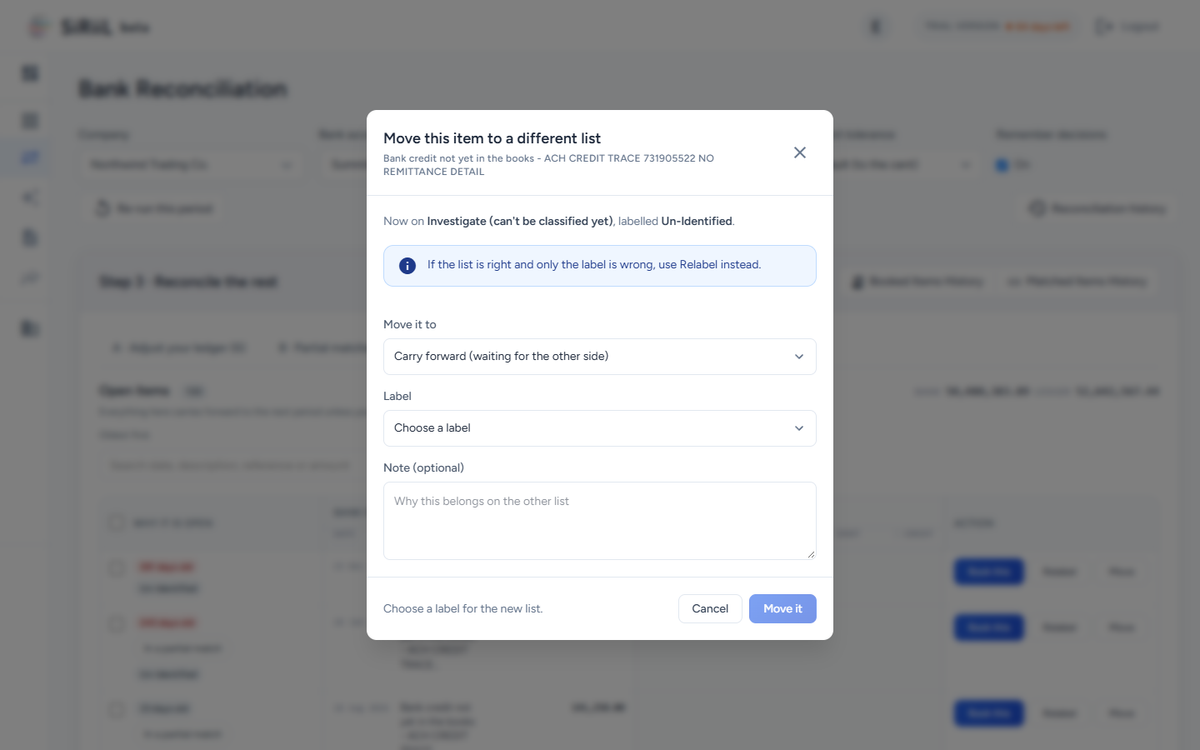
The user can also choose a new label and add a note explaining the change before confirming. This gives accountants control over correcting classifications and deciding how unmatched transactions should be handled.
Retaining Institutional Memory
This controlled environment is enhanced by a memory management system. Every cycle, the platform learns more about your specific workflows, rules, and company context. When you correct a classification or dismiss a match, the system remembers. The more you use it, the faster and more reliable your outcomes become. This creates a permanent institutional memory that survives team turnovers.
A Real Month-End Workflow in SiRiiL
To see how this memory and strict matching logic play out in practice, let us walk through a real scenario using SiRiiL.
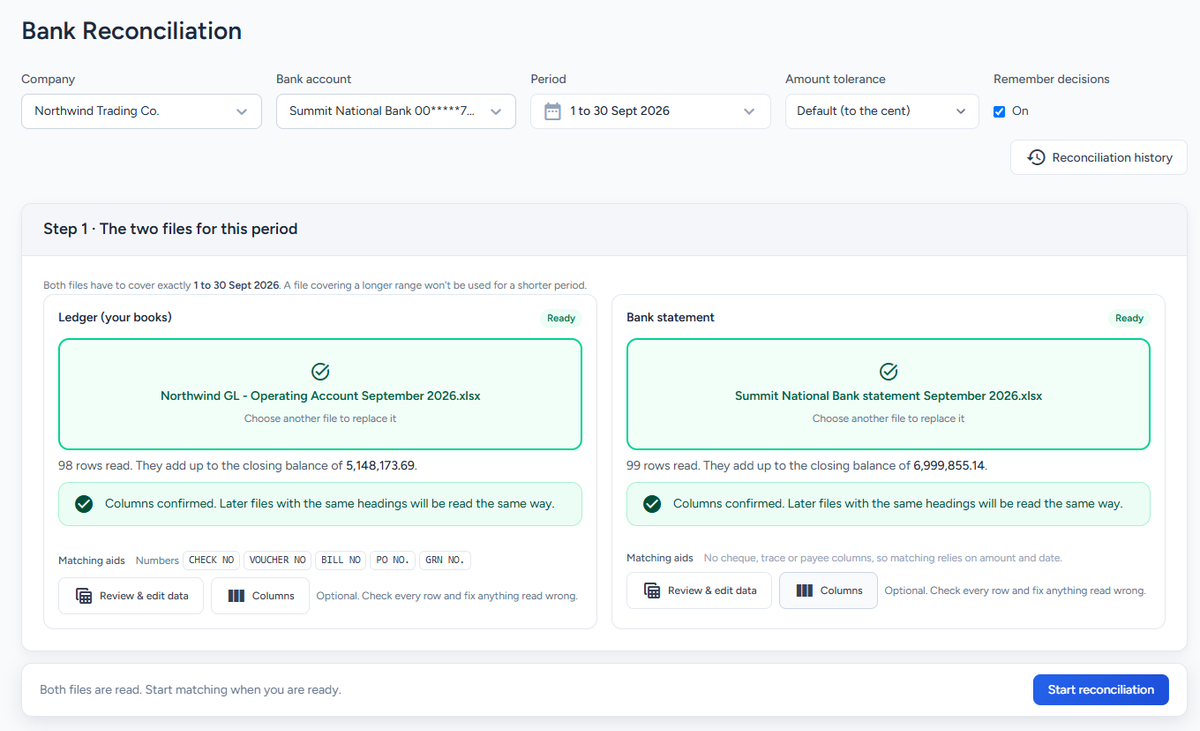
Emma Clarke is the Financial Controller at Northwind Trading Co. She is reconciling their US Dollar operating account held at Summit National Bank for the month of September. After completing a simple one-time setup to establish her opening balances, Emma uploads her September ledger export and her Summit National Bank statement.
The software reads 98 ledger rows and 99 bank rows and instantly pairs every match it can prove. Emma is left to review only the exceptions. Here is exactly how she handles them.
Flagging and Resolving Transposed Numbers
Even when reference numbers match perfectly, a simple typing error disrupts manual reconciliations for hours.
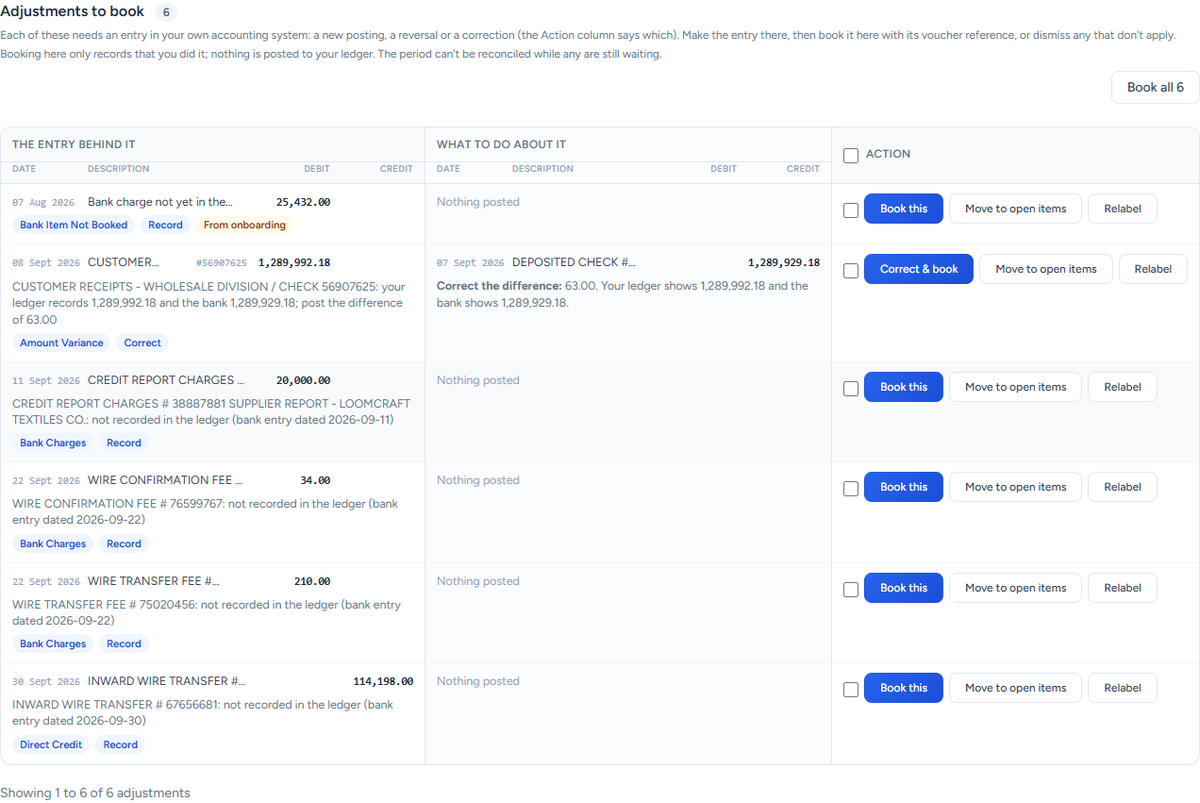
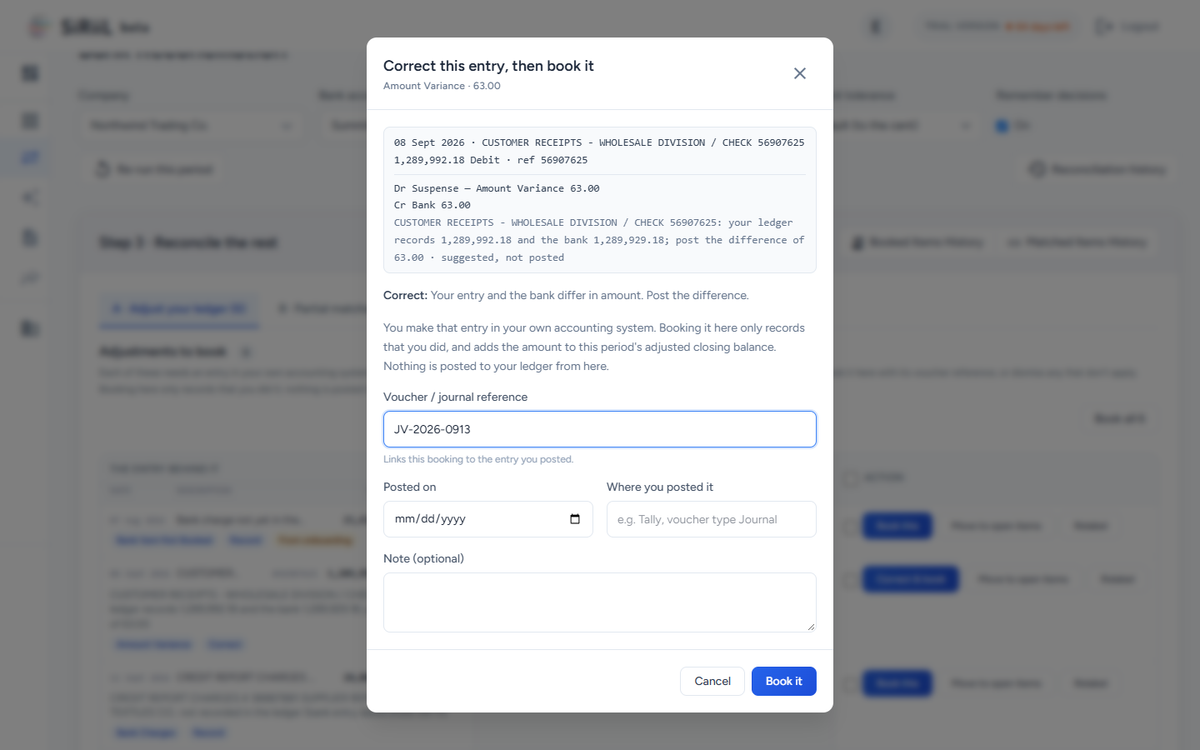
As you can see here, in the September files, Northwind deposited check number 56907625. Emma's ledger shows a debit of 1,289,992.18. The Summit National Bank statement shows a credited amount of 1,289,929.18. A bookkeeper transposed two numbers.
In a spreadsheet, Emma would have to hunt for a hidden $63.00 variance. In SiRiiL, the system identifies the reference match immediately, places the items side-by-side in its list of adjustments to book, and flags the exact $63.00 difference. It then prompts Emma to correct the difference by posting a journal entry, exactly as shown in this view:
Booking Unrecorded Bank Charges
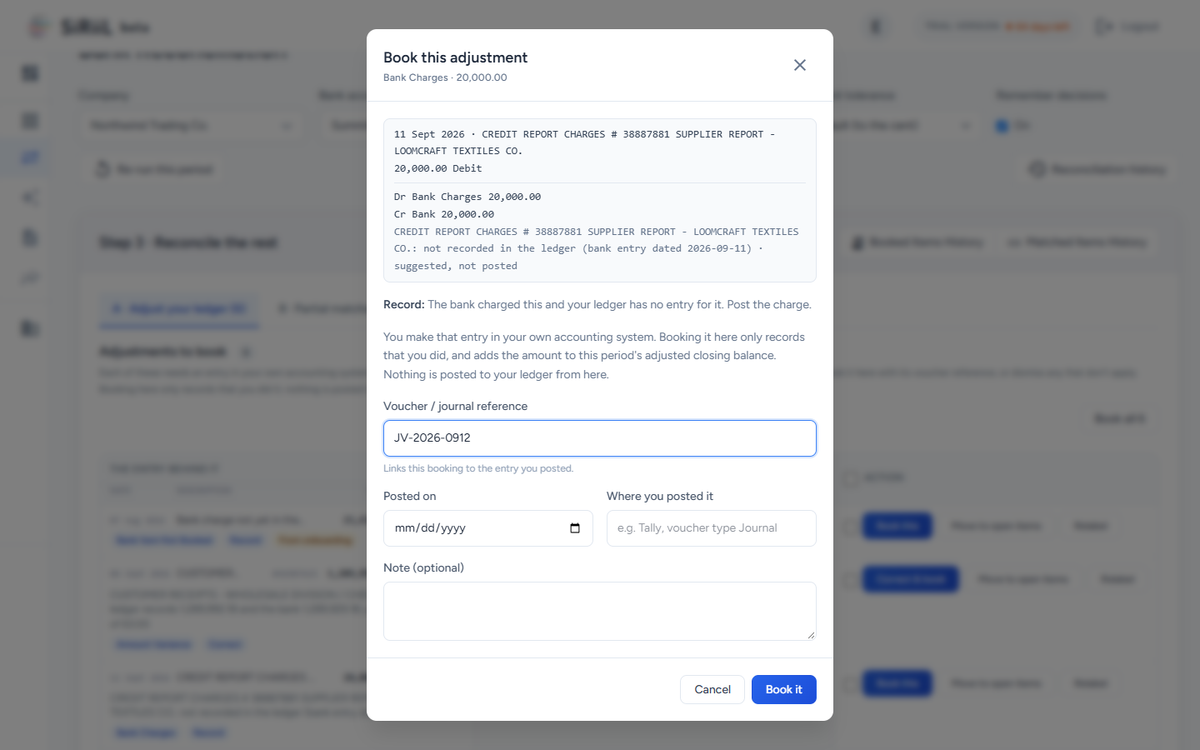
Bank charges often clear the account before the finance team receives any notification. During Emma's review of the September statement, the software flags a $20,000.00 withdrawal for "CREDIT REPORT CHARGES - LOOMCRAFT TEXTILES CO." The system searches her ledger and finds no corresponding entry.
The AI categorizes this as "Bank Charges". This is where the human-in-the-loop design shines. SiRiiL does not automatically post this to Emma's accounting system. Instead, it provides a suggested journal entry right on the screen.
The image below shows how Emma opens her own accounting system, posts the missing $20,000 charge, and types her actual journal reference (like JV-2026-0912) into SiRiiL. This ties the system's record to the real entry. Auditors can then trace every single adjustment back to its exact source.
Clearing Identical Open Items Manually
Sometimes, matching requires human context that algorithms rightly refuse to guess.
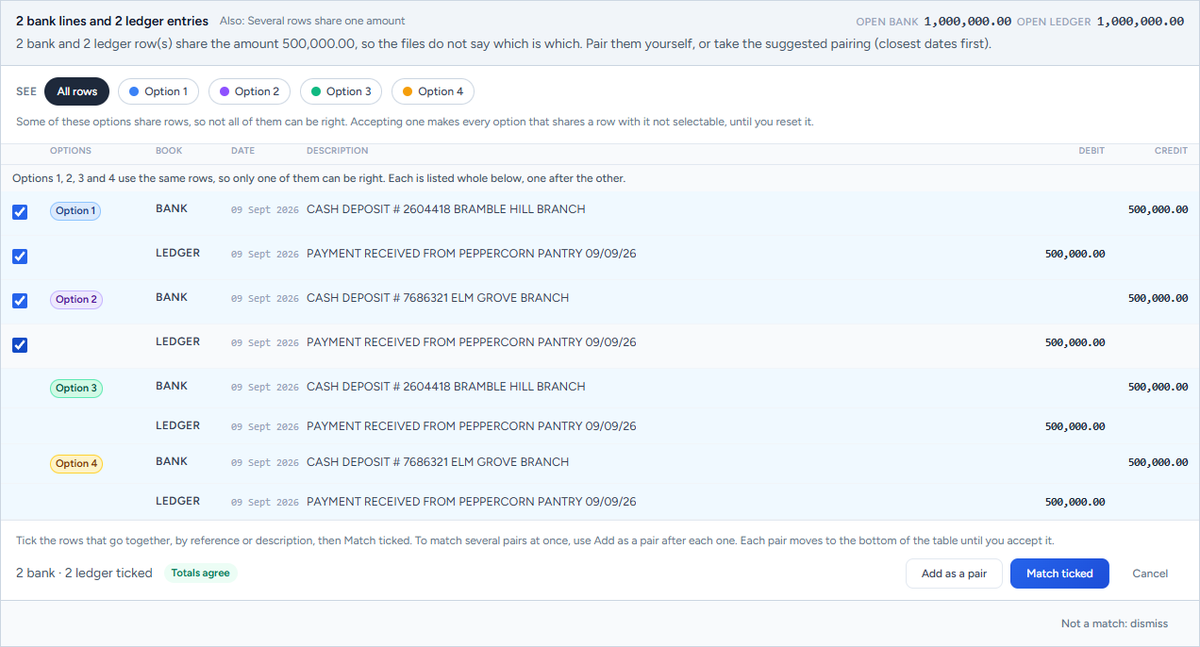
On September 9th, Northwind received two identical cash deposits of $500,000.00 each into their Summit account from two different branch locations. On the exact same day, the Northwind ledger recorded two identical $500,000.00 payment receipts from the same customer.
Because all four amounts and dates are identical, the system cannot mathematically prove which specific ledger receipt belongs to which specific bank branch deposit. The software leaves all four items unmatched instead of guessing and creating a false audit trail, and groups them under Partial matches with a note that the files do not say which is which. As illustrated below, Emma selects "Pair them myself", ticks all four rows, and clicks "Match ticked" to clear them together using her own contextual knowledge.
Required Features for Audit-Ready Books
Beyond clearing individual matches, you need capabilities that satisfy auditors and managers alike when evaluating tools to replace your spreadsheets. Marketing hype does not survive a rigorous financial audit.
Tracking Open Items Across Months
Reconciliation is continuous. An unpresented check written in August might clear in October. Effective systems maintain an open items ledger that carries unresolved differences forward automatically. You should be able to see the exact age of each reconciling item in days, complete with visual badges as they age.
Maintaining an Append-Only Action Log
Auditors require absolute proof of who approved every adjustment. You need a system that maintains an append-only action log. Every time you accept a match, reverse an entry, or book a journal adjustment, the software must record your identity and timestamp.
Generating the Final Reconciliation Statement
The end goal of this entire process is a proven, balanced statement. When Emma finishes her review, SiRiiL generates the final Bank Reconciliation Statement and a Schedule of Ledger Adjustments. This schedule lists the adjustments Emma confirmed as posted, together with their corresponding voucher references. It provides a supporting record of the adjustments made during reconciliation and helps establish that the adjusted closing balances are tied to zero.
Frequently Asked Questions
Is AI bank reconciliation secure and auditable?
Yes. The best platforms use zero data retention models. This means your financial data is never stored or used to train public AI. For auditability, systems like SiRiiL maintain an append-only action log. Every matched transaction, adjusted entry, and user approval includes a strict timestamp and the specific user's name.
Will this replace my current accounting system like QuickBooks or Xero?
No. Bank reconciliation software works alongside your existing ledger. You export your data from your accounting software, run the automated matching in the reconciliation tool, and then manually post any suggested journal entries back into your main ledger.
How much time does automated reconciliation save?
It depends on your transaction volume. For a ledger with several thousand rows, a platform using deterministic-first matching typically pairs over 90 percent of transactions in under a minute. The finance team then spends ten to fifteen minutes reviewing the exceptions, rather than spending days ticking off a spreadsheet.
Can the AI post incorrect entries to my general ledger?
No. Reliable reconciliation tools use a strict human-in-the-loop design. The software groups unmatched items and suggests the required journal entries, but it never pushes data directly into your ledger without your explicit approval. You always review the suggestions and post the final entries yourself.
Eliminating the Month-End Bottleneck
Automating bank reconciliation is not about replacing accountants. It is about relieving the real pain points you face every single month. By pairing strict deterministic math with contextual AI and human oversight, you eliminate spreadsheet chaos and reclaim dozens of hours.
We built SiRiiL because we lived through the last-minute closings and endless manual matches for decades. We invite you to explore the platform to see how our memory management, intelligent adjustment suggestions, and audit-ready reporting work for real businesses.
Start your free trial with SiRiiL today or watch our product demo to see Emma Clarke's full workflow in action.


